15 ways to save money on buprenorphine treatment
- updated November 2014 -
Generic buprenorphine sublingual tablets – On February 25, 2013
the FDA approved generic equivalents for Suboxone®(Bup/Nx) sublingual tablets
- (not the film) - in 2mg and 8mg sizes. In October 2009 generic
Subutex® (Bup) sublingual tablets in 2mg and 8mg sizes were approved. Prices for generics have not yet dropped significantly below brand-name products. Generic buprenorphine - Buprenorphine Pipeline Pharmaceutical Manufacturer's Copay cards – Patients can get discounts (see websites for minimum purchases, details and restrictions) of out-of-pocket branded product costs. The copay cards can be printed from the manufacturer's websites and presented to the pharmacist. They can be used to cover all or part of the insurance copay or to save cash-paying patients.
- Suboxone Film® (Bup/Nx) - $50 off - 14 film minimum, can be used once per month. Example; a patient who requires 60 films/month can get $50 off per month of out-of-pocket costs. Patients prescribed 13 films or less are ineligible for the discount. Expires: 12/31/2014
- Zubsolv® (Bup/Nx) - This card provides a $2.50 discount off each tablet (no minimum), toward out-of-pocket costs, up to $225 per use and can be used multiple times per month. Example; a cash paying patient who requires 60 tablets/month would receive $150 discount per month. Expires: 6/30/2015 Sub-to-Zub Dose Converter Calculator
- Bunavail™ (Bup/Nx)buccal film - With this card your first prescription is FREE (see details). After that, the card can be used to save up to $100 off out of pocket costs exceeding $10. You must provide your name and address to enroll in the discount program. Sub-Bunavail Dose Conversion Calculator
Pharmaceutical Manufacturer's FREE meds program –Some manufacturers of buprenorphine products have launched patient assistance programs (PAP) to help low income patients afford their medication. Some patients qualify for FREE medication for up to a year. Each program have their own procedures, qualification criteria, restrictions and rules. Click to find details about the Suboxone Film PAP and the Zubsolv PAP. Marketing research opportunities – Occasionally, research firms want to survey patients in buprenorphine treatment and often offer some sort of honorarium, usually $25-$100 depending on the length of the survey. These are typically anonymous and take 5-20 minutes to complete. naabt.org and AddictionSurvivors.org will post listings of opportunities once they become available and are verified as legitimate.
Buy your own drug test kits online – Most physicians conduct urine tests for illicit drugs at each office visit.
Often, the urine is sent to a lab for processing, this can be expensive. If the physician is willing, the patient can
purchase drug test kits online for under $10. This could save hundreds depending on how often and how many drugs are tested for. Third-party prescription discount cards – There are a number of discount cards available from sources
like AAA, some pharmacy chains and discount prescription websites. The AddictionSurvivors.org discussion board has an area dedicated to
discussing these cards and gives the opportunity to hear from people who actually used them. Each card has its own conditions, terms and
discount rate. Details Addiction Treatment Insurance – If the physician doesn't accept private insurance, claims can be submitted to the insurer for direct reimbursement. Check the insurer's website for the self-reimbursement forms or contact the insurer's claims department for the proper forms and instructions. Many patients do this successfully as many physicians still do not accept insurance for buprenorphine treatment. More on insurance Partial prescription dispensing – If patients can't afford the entire prescription all at once, they can ask the pharmacy to dispense a partial prescription. This type of partial dispensing should not count as a refill. Although this doesn't actually save any money, it may be a way to afford to stay in treatment when there isn't enough money to purchase the entire prescription. Clinical trials/studies
with buprenorphine– Can be a source of both
free medication and free medical care, although the patient will be subject to whatever conditions are set up in the study. Look for open label Phase IV studies which means the medication is already FDA approved and you will know what medication is being provided.
www.clinicaltrials.gov Negotiate with the provider – Patients may be able to negotiate a lower price with their physician or counselor, particularly if you have been a long-term stable patient. Less frequent office visits – As the patient stabilizes, s/he can request to have less frequent office visits. Although physicians commonly require patients to come in for appointments every month to monitor the patient's progress, schedule III medications can be refilled up to 5 times in a 6 month period. Visit frequency is ultimately determined by the physician, but it doesn't hurt to ask, particularly for those stable in long-term addiction remission and those who get therapy or counseling from other sources. Some states however, overrule the physician's judgment and have set minimum periods between office visits. Lower buprenorphine dose – If the patient has been stable for several months, s/he may find that a lower dose still suppresses cravings and withdrawal symptoms. Discuss this with the physician, of course, to make sure that no more medication is being taken, and paid for, than is needed to maintain addiction remission. Also, doses above the patient's ceiling dose provide little, if any, additional benefit. The correct dose is the lowest dose which still suppresses cravings and withdrawal. Physician Referral fee – Some physicians will provide a referral fee or discount when patients are directly referred to treatment. Methadone Clinics (OTPs) – Some methadone clinics (OTPs) also offer buprenorphine. This varies state to state and clinic to clinic but it may be subsidized in some way and available at reduced cost. However, find out the rules and dispensing criteria for each clinic beforehand, which often initially consists of daily witnessed dosing at the clinic. Shop around – Shopping around for a good value is not what is meant by the term "doctor shopping" which refers to seeing several doctors for the same ailment without the other doctor's knowledge. The intention of "doctor shopping" is to obtain multiple prescriptions, often opioid pain relievers, from multiple doctors. Shopping around for a good value is prudent so long as it doesn't delay the commencement of life-saving treatment. One strategy is to begin treatment immediately then search for better value later.
See doctor shopping
| |
AddictionSurvivors.org
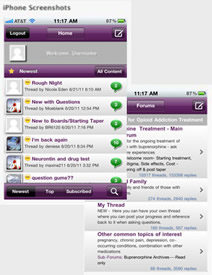
Addiction Survivors goes mobile.
 Get the App for your iPhone or Android-based phone and have access to the Addiction Survivors community whenever and wherever you need it, and its free. Get the App for your iPhone or Android-based phone and have access to the Addiction Survivors community whenever and wherever you need it, and its free.
iPhone | Android
Free Peer Support Referral
Cards – while supplies last! We have
referral cards to AddictionSurvivors.org
available for no charge.
In some parts of the country patients
cannot find live support groups that
understand the challenges and benefits
of medication assisted treatment. The
Addiction Survivors patient community
is available 24/7.
To order free cards: email us at
MakeContact@AddictionSurvivors.org Please include your
name, street address and how many
cards you would like.
naabt.org
6 ways to find buprenorphine treatment – Not all doctors can prescribe buprenorphine. In fact only about 22,170 of the 800,000 U.S. physicians (2.7%) have the necessary credentials to prescribe it for addiction. In addition those who can prescribe have limits on how many patients they can treat.
To become certified doctors must take an 8-hour course and file a request. This can be done online. See this link for more information You can ask your doctor to become certified.
Click Here for the Six Ways to Find Buprenorphine Treatment
Patients and Prescribing
Physicians. Patients and prescribing physicians
can now order a free "in case of
emergency" wallet card that alert
healthcare workers that buprenorphine
can affect opioid pain medication.
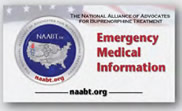
The card also lists a link to this
web page: www.naabt.org/emergency with important relevant links useful
if opioid pain treatment becomes
necessary. Simply email us a mailing
address to send the card to at MakeContact@naabt.org
Voluntary Disclosure: Some of the funding for this
organization is provided by anonymous donors
whose lives were touched by evidence-based
addiction treatment and were willing to help
support our mission. NAABT, Inc. has also asked for and accepted
funding from pharmaceutical companies in the
form of "Unrestricted Educational Grants." The
grants are "unrestricted" so that there are no
"strings" attached. NAABT, Inc. has complete
control over how the funds are used, there are no
restrictions on the content or mission of this site,
and donors have no control over the content of the
site or NAABT's activities. NAABT, Inc. is solely
responsible for all of its activities.
Click here to learn more about NAABT.
|
|